Here are some strategies on how to eliminate answers when doing NCLEX Basic Care and Comfort questions, so that you can get more questions correct on the NCLEX Nursing exam.
#1: Know what the question is asking: the Problem
A lot of students read the question super fast and don’t really try to figure out exactly what the question is asking. Every question is a problem and you want to figure out what the problem (or situation) is. So slow down and read the question carefully so you know what it is asking.
#2: Do you need more assessment data or can you just implement an action?
Here’s a question:
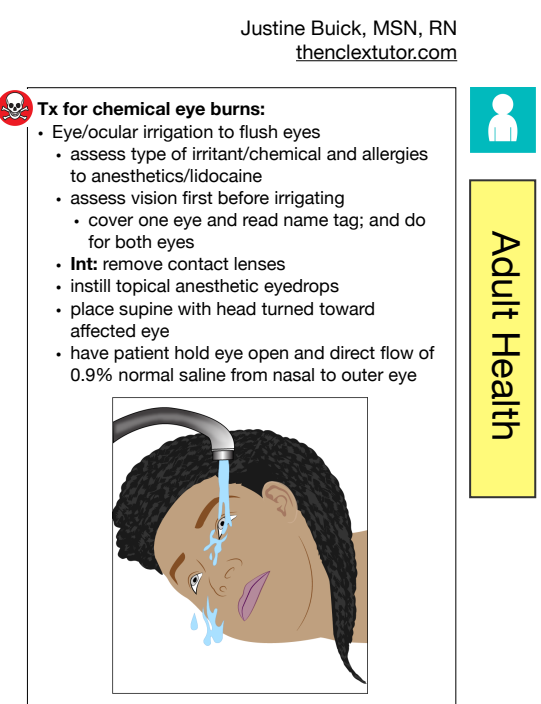
The client has come into the emergency room reporting to the nurse that they have splashed a chemical in their eyes. The client reports their eyes are burning and are having trouble seeing. The client does not remember the chemical name.
Which should the nurse do immediately?
- Ask client what they were doing when the splash
occurred - Ask client if they wear contact lenses
- Flush eyes with tap water
- Call poison control center
Break your answers up into assessments (getting more data) or interventions (actions that help with the situation). If you have enough assessment data in the question and you know what is happening, then choose an answer that helps with the problem.
This is how I eliminate answers.
- Ask client what they were doing when the splash occurred – don’t need assessment because the chemical is currently in the eye and the client will lose their sight of the nurse doesn’t intervene
- Ask client if they wear contact lenses – don’t need this assessment because of the chemical currently in the eye
- Flush eyes with tap water – intervention – this helps because this will prevent further damage to the eye – ANSWER
- Call poison control center – don’t need to do this since we know as nurses to flush the eye out first
#3: What would require you to INTERVENE is the incorrect or Bad answer
Here’s an example:
The nurse is teaching a client on how to use a walker.
The nurse would need to intervene if the client was doing which of the following?
- Leaning onto the walker when stepping with the injured leg
- Adjusting the height of the walker to be 2 inches (5 cm) above waist level
- Putting all four points on the floor before leaning on the walker
- Moving the walker forward about 8 inches (20 cm) before taking the first step
Break your answers up into Good/Bad or Correct/Incorrect and label each answer. In this case, you are looking for the incorrect or bad answers.
This is how I eliminate answers.
- Leaning onto the walker when stepping with the injured leg – this is correct since this stabilizes the patient and prevents them from falling – this is SAFE to do
- Adjusting the height of the walker to be 2 inches (5 cm) above waist level – this is incorrect since the arm would be too high up and the client would have trouble balancing. ANSWER
- Putting all four points on the floor before leaning on the walker – this is correct since this would also stabilize the patient and prevent them from falling
- Moving the walker forward about 8 inches (20 cm) before taking the first step – this is correct since we would tell the client to move the walker forward anywhere between 6-12 inches for stabilization.
#4: Know the basic patho
Seems obvious right? But it’s not always obvious. In the past, I have had students tell me that instructors have told them “it’s not about the content, it’s about critical thinking”. This is the dumbest statement. Of course it’s about the content! You have to know stuff to take care of patients and to answer test questions. You have to know content! So as you do questions, always try to state the basic patho. You will definitely get more answers correct.
Here’s an example.
The nurse is caring for a client with coronary artery disease.
Which dietary recommendation would the nurse include in the discharge instructions?
- Limit of intake of whole grains
- Limit intake of tuna
- Limit intake of soybean products
- Limit intake of egg yolks
First be able to say a quick patho/cause of the disease. CAD is clogged arteries caused by increased cholesterol and plaque which causes poor circulation in the arteries. Then you can break down what is in each of the foods.
This is how I eliminate answers.
- Limit of intake of whole grains – whole grains have complex carbs and fiber – no cholesterol
- Limit intake of tuna – tuna has protein – no cholesterol
- Limit intake of soybean products – soybeans have protein and some vitamins and minerals – no cholesterol
- Limit intake of egg yolks – egg yolks have a lot of cholesterol which can clog arteries – ANSWER
Basic Care and Comfort is a variety of content topics
Basic care and comfort is a variety of topics that students may not know to study.
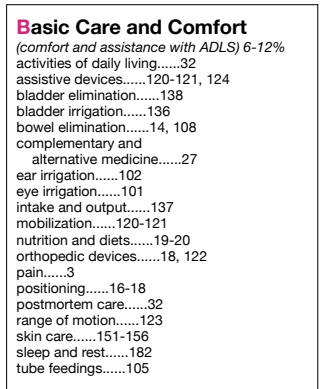
But I got ya! Below is a list of the common topics taken directly from the 2026 NCLEX test plan. For my students, I can tell them exactly what to study by having them use my NCLEX Nugget Book.
This list comes directly from my 2026 NCLEX Test Plan Index, which my students use to review content.
Interested in tutoring? Reach out by contacting Justine through thenclextutor.com/contact

